
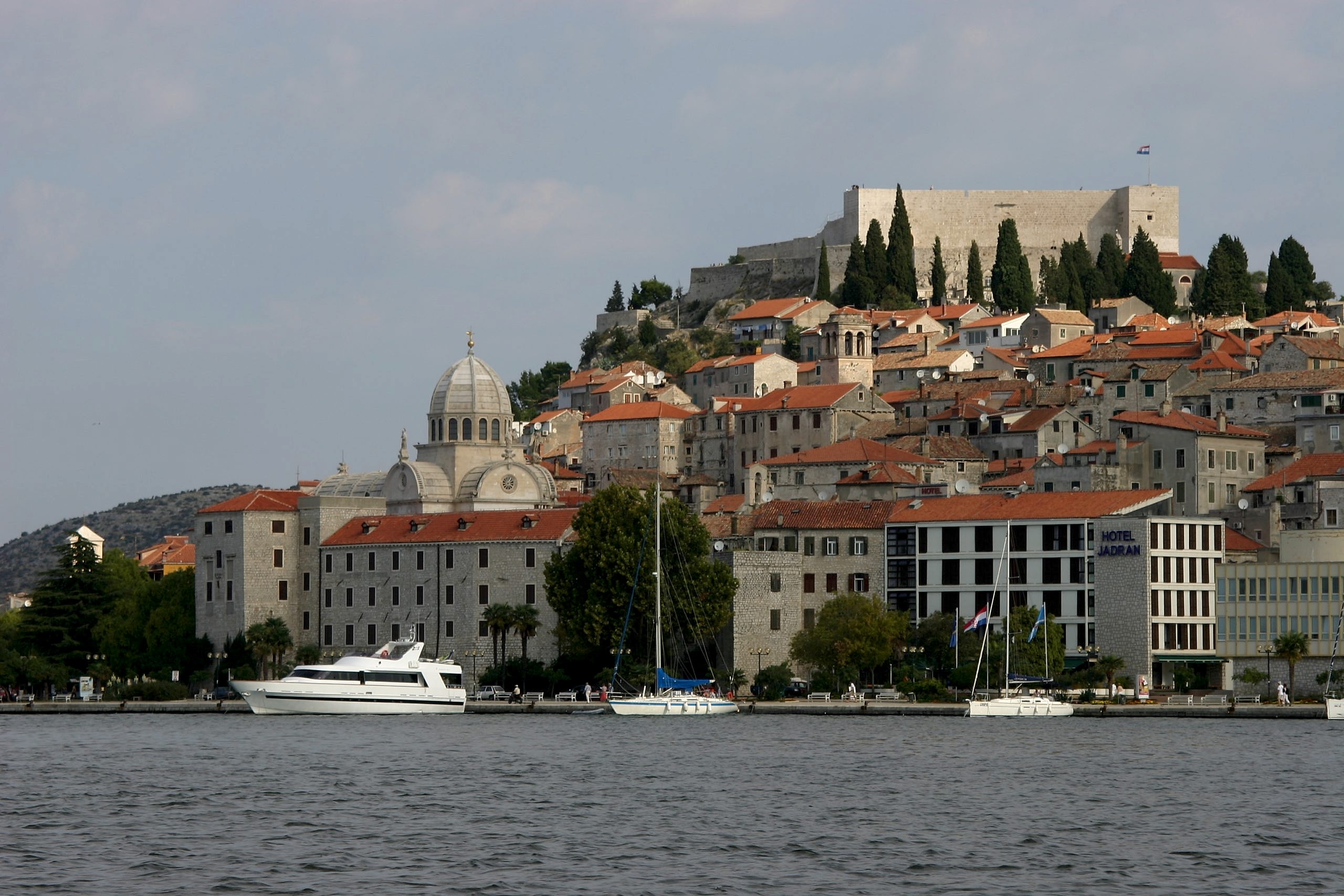
Šibenik And Its UNESCO Attractions
Now we’ve announced Šibenik as the destination for our 2027 Croatian Language and Culture Course, of course we’re taking a keen interest in what the press says about it. We came across an article a couple of week’s ago, link at the end of the post, celebrating its value and charm compared to more discovered Dalmatian cities like Dubrovnik. However, we thought it was time to clear up one area of confusion that often occurs when Šibenik is in the spotlight: its UNESCO World Heritage status which is much more nuanced than often appears in the press.
To be absolutely accurate, Šibenik has a standalone UNESCO site – The Cathedral of St. James (Katedrala sv. Jakova), inscribed in 2000, and a site – St. Nicholas Fortress (Tvrđava sv. Nikole) – which is a component part of a much wider inscription.

The Cathedral Of St. James, A Standalone UNESCO Listing
 UNESCO recognizes St James Cathedral as an outstanding example of the artistic and architectural interconnectedness between Northern Italy, Dalmatia and Tuscany during the 15th and 16th centuries. The building was constructed between 1431 and 1535 and was developed by three successive architects: Francesco di Giacomo, Georgius Mathei Dalmaticus (Juraj Dalmatinac) and Niccolò di Giovanni Fiorentino (Nikola Firentinac). UNESCO highlights the construction – it was built entirely from stone and employed innovative techniques for its vaulting and dome. The building is also celebrated for its successful blending of Gothic and Renaissance architecture, making it a significant illustration of the transition between the two artistic periods.
It is also distinctive for the exterior frieze decorated with the sculptured faces of men, women and children. Various theories abound as to the significance of the faces including a suggestion that those families included had not contributed to the funding of the project and so were to be shamed in perpetuity!
St Nicholas Fortress, Part Of The UNESCO Listing “Venetian Works of Defence between the 16th and 17th Centuries: Stato da Terra – Western Stato da Mar”
 When UNESCO added the “Venetian Works of Defence between the 16th and 17th Centuries: Stato da Terra – Western Stato da Mar” to the World Heritage List in 2017, it recognised one of the most important military landscapes of the Renaissance. The inscription comprises six interconnected defensive sites spread across Italy, Croatia, and Montenegro, illustrating the way in which the Republic of Venice protected both its mainland territories and its maritime empire in a military era that had recently been transformed by the use of gunpowder.
Croatia has two of these six components: St. Nicholas Fortress in Šibenik and the Defensive System of Zadar. There are three in Italy – the Fortified Cities of Bergamo and Peschiera del Garda, and the City Fortress of Palmanova; and one in Montenegro – the Fortified City of Kotor.
Of Croatia’s two components, St. Nicholas Fortress is arguably the most dramatic. Located at the entrance to St. Anthony’s Channel near Šibenik, it was built on a small island at the channel entrance in the 16th century to protect the city and its port from attacks by sea. Its position allowed defenders to control access to Šibenik’s harbour and the Krka estuary beyond.
Šibenik is actually known for its four fortresses, but only St. Nicholas Fortress forms part of the UNESCO inscription. The city’s other major fortresses—St. Michael’s, Barone, and St. John’s—remain important historic monuments but are not included in the World Heritage designation.

For more information:
The Cathedral of St James in Šibenik – UNESCO World Heritage Centre
Images and text © Jane Cody and Croatian Language School Ltd 2026